- 14 flights across 4 sites; 3 exceptions flagged, 0 escalations
- One concrete form misalignment caught before the pour — avoided a potential $40k strip-and-re-pour
- Tuesday morning is the most valuable flight window of the week, for reasons beyond light angle
Why Tuesday mornings
Monday is the catch-up day. Crews return from the weekend, equipment moves into position, and the foremen are running the meetings they didn't have time for on Friday. Nothing much happens before noon on Monday that you'd want a record of — unless your project has a scheduling problem serious enough that crews are working weekends and Mondays to close gaps.
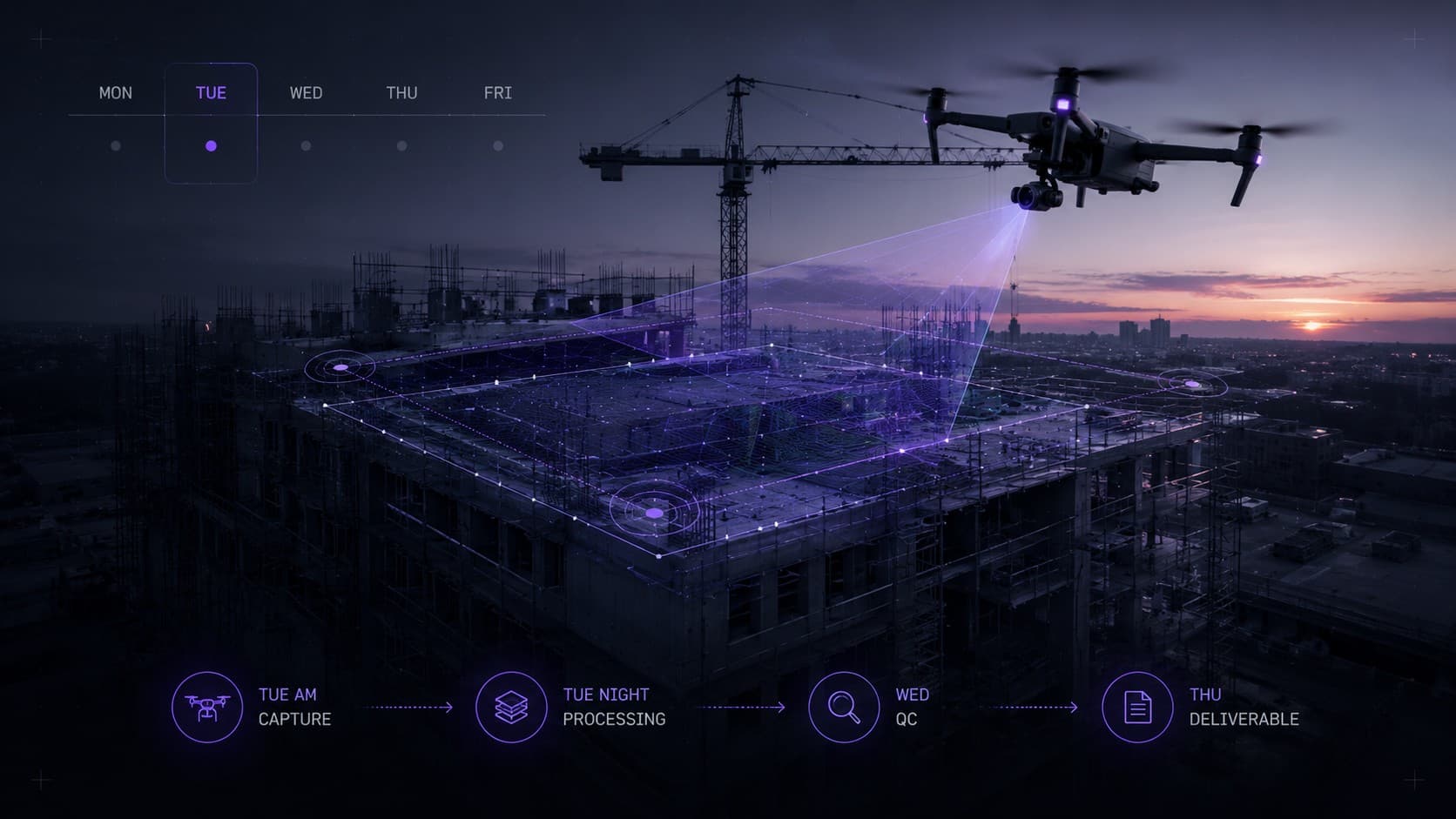
Tuesday morning, by contrast, is when the week's work plan is locked and crews are actually executing against it. A 7am capture on Tuesday gives you a true start-of-week baseline, and it gives the GC something to put in their Wednesday progress meeting. That cadence — fly Tuesday, deliver Thursday, meet Friday — is how most of our programs run.
There's also a light angle argument. Early morning light at lower angles makes surface texture visible — you can see whether concrete has been stripped, whether a slab is finished or still green, whether that pile of material is aggregate or spoil. Midday overhead light flattens everything.
“A form misalignment caught at 7am is a 10-minute phone call. Caught after the pour, it's a $40,000 strip and re-pour and a schedule impact that hits the lender's next draw.
The exceptions this week
Three of the four sites produced exceptions this week. Here they are in full, with severity and outcome. Exceptions are conditions that deviate from the approved site plan or schedule; they go into the shared workspace and trigger a notification to the PM and GC within the hour.
What we tell the trade
When we raise an exception, the note to the GC is specific: site name, grid reference, what we see, and what the approved plan shows. We don't editorialize. "Form on Grid E-8 is 14 cm south of the layout line per the Apr-21 drawing set" is actionable. "Something looks off on the north face" is noise.
The GC on Tower 04 has been with us for 11 weeks. He knows the note format, he knows where to find the photo, and he knows that if we flag it, it's worth a walk. That trust is built over months, not one good catch. The bad version of this relationship is an operator who cries wolf on every minor deviation — eventually nobody walks the flag.
The other thing we tell the trade: the aerial is documentation, not oversight. We're not on-site personnel, we don't stop work, we don't issue instructions to crews. We flag to the PM and GC and they decide what to do with it. That distinction matters — both for liability and for keeping the relationship functional.
The method
Each Tuesday flight follows the same pattern: nadir pass at 120m for the orthomosaic, oblique passes at 60m for detail, targeted low-altitude captures at any flagged areas from the previous week. GCPs are set by the ground crew before first light.
Processing runs that afternoon. By Tuesday evening the orthomosaic is built and in the workspace. The overlay — current ortho draped over the design model — is rendered overnight. Deliverables drop into the client workspace before 8am Wednesday. The client has 24 hours to review before the weekly site meeting.
The value isn't the photo. It's the cadence — the predictable, same-time-every-week record that lets a project team build a decision rhythm around it. Cameras are cheap. Consistency is what's hard.